Why Was The Microwave Oven Invented And Why It Matters
The microwave oven was invented by accident when engineer Percy Spencer noticed a chocolate bar melting near a magnetron during radar research. This unexpected discovery in 1945 led to the creation of the first microwave cooking device, forever changing how people prepare and heat food. Today, the microwave oven is one of the most essential kitchen appliances in homes worldwide, offering unmatched speed and convenience.
Have you ever wondered why was the microwave oven invented? It is one of those kitchen gadgets we use every single day without giving it a second thought. But the story behind this amazing cooking appliance is anything but ordinary. It involves radar technology, a melted chocolate bar, and one brilliant engineer who saw potential where others saw nothing.
The microwave history is a fascinating journey from wartime military research to the heart of your kitchen. Understanding why the microwave oven was invented gives you a deeper appreciation for this everyday household appliance. More than just a quick way to reheat leftovers, the microwave oven represents one of the most impactful kitchen appliance innovations of the 20th century. Let us dive into the full story.
Key Takeaways
- Accidental Discovery: The microwave oven was invented by pure accident when Percy Spencer observed a candy bar melting near radar equipment.
- Radar Technology Connection: The invention stemmed directly from World War II radar research and magnetron technology.
- Percy Spencer’s Genius: A self-taught engineer from humble beginnings, Spencer turned a military technology into a household kitchen staple.
- First Microwave Was Massive: The original Radarange weighed over 750 pounds and stood nearly six feet tall.
- Modern Kitchen Essential: Today, over 90% of American households own a microwave oven, proving its lasting importance.
- Energy Efficiency: Microwave cooking uses significantly less energy than traditional ovens, saving money and time.
- Continuous Evolution: From the first commercial model to today’s smart microwaves, the appliance keeps getting better and more versatile.
📑 Table of Contents
- The Accidental Discovery That Changed Everything
- Percy Spencer: The Man Behind the Microwave
- How the First Microwave Oven Actually Worked
- Why the Microwave Oven Matters Today
- The Evolution of the Microwave Oven Over Decades
- Common Myths and Misconceptions About Microwaves
- The Lasting Impact of the Microwave Oven Invention
- Conclusion
The Accidental Discovery That Changed Everything
The invention of the microwave oven is one of the greatest happy accidents in the history of technology. In 1945, an engineer named Percy Spencer was working on radar technology for Raytheon Corporation. He was surrounded by magnetrons, the devices that generate the microwave radiation used in radar systems. One day, while standing near an active magnetron, he noticed something strange.
A chocolate bar in his pocket had melted completely. Most people would have just brushed it off. But Percy Spencer was not most people. He was curious. He wanted to understand what was happening. So he started experimenting.
How a Chocolate Bar Led to a Revolution
Percy Spencer began testing different foods near the magnetron. He tried popcorn kernels first, and they popped almost instantly. Then he tried an egg, which exploded in the face of a nearby colleague. These experiments proved that microwave energy could heat food rapidly and effectively. Spencer saw the potential immediately.
This was not just a fun science experiment. Spencer recognized that this electromagnetic wave technology could completely transform how people cook and prepare meals. The idea of rapid heating and convenience cooking was born right there in the laboratory. What started with a melted candy bar would eventually become a multi-billion dollar industry.
The Role of Radar Technology in the Invention
To understand why was the microwave oven invented, you need to understand the context of World War II. During the war, radar became a critical military technology. Radar systems relied on magnetrons to generate high-frequency electromagnetic waves. These waves could detect enemy aircraft and ships from great distances.
After the war, Raytheon Corporation held many patents related to magnetron technology. Percy Spencer, who had worked on magnetron production during the war, was in a unique position. He understood the technology inside and out. He also understood that the same microwave radiation used for detecting enemies could be used for something completely different: cooking food.
This connection between radar technology and food heating was the foundation of the entire microwave invention story. Without wartime radar research, the microwave oven might never have been developed when it was.
Percy Spencer: The Man Behind the Microwave
Every great invention story has a compelling human behind it. Percy Spencer’s life is the kind of story that inspires people to this day. He was born in 1914 in Portland, Maine. His father died when he was just three years old. His mother struggled to make ends meet. Percy had very little formal education. He dropped out of school by the time he was twelve.
Despite these humble beginnings, Percy Spencer was a self-taught genius. He was naturally curious about how things worked. During World War I, he joined the United States Navy. While serving, he read many textbooks on electrical engineering to teach himself the subject. By the time he joined Raytheon after the war, he had become one of the most skilled engineers in the company.
From Humble Beginnings to Innovation
Spencer’s lack of formal education never held him back. In fact, many colleagues said his practical, hands-on approach to problem-solving was his greatest strength. While other engineers got bogged down in theory, Spencer could build and test things quickly. He had an intuitive understanding of electromagnetic technology that few people possessed.
When Spencer noticed the melting chocolate bar, he did not just shrug and walk away. He pursued the idea with relentless curiosity. He filed for a patent on microwave cooking technology. He worked with Raytheon to develop a practical cooking appliance based on his discovery. His journey from a poor farm boy in Maine to a celebrated inventor is truly remarkable.
The First Microwave Cooking Experience
The first successful test of microwave cooking using popcorn was a thrilling moment for Spencer. But the real breakthrough came when he realized the technology could be scaled up. He worked on creating a device that could cook food reliably and safely for everyday use.
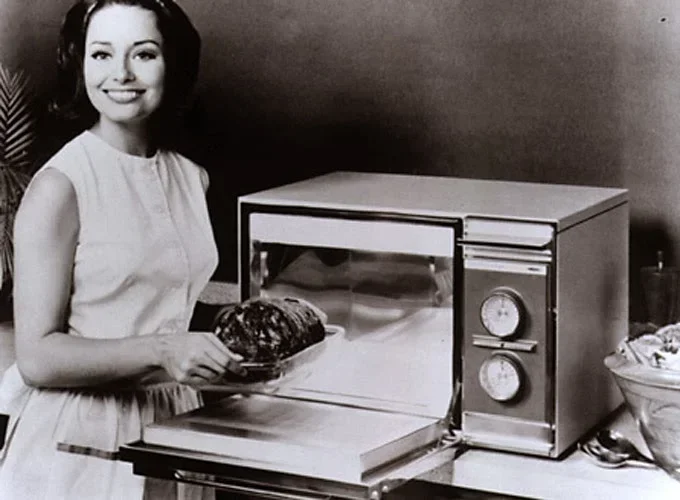
The first commercial microwave oven, called the Radarange, was introduced in 1947. It was enormous. It weighed over 750 pounds and cost nearly $5,000. That is about $55,000 in today’s money. Obviously, it was not something the average household could afford. But it proved the concept worked. Microwave technology had real potential as a food preparation tool.
How the First Microwave Oven Actually Worked
Understanding how the first microwave oven worked helps you appreciate the microwave technology that powers it today. At the heart of every microwave is a component called a magnetron. This is the same device that was used in wartime radar systems.
The magnetron converts electrical energy into microwave radiation. These microwaves are a form of electromagnetic radiation with a specific frequency that causes water molecules in food to vibrate. When water molecules vibrate, they generate heat. This is how food heating happens inside a microwave oven.
Understanding Magnetron Technology
The magnetron is a vacuum tube that uses a magnetic field to generate microwaves. It was originally designed to produce high-power radar pulses. Percy Spencer realized that the same energy could be directed into a cooking chamber. The microwaves would bounce around inside the metal box and penetrate food, heating it from the inside out.
This is fundamentally different from how a traditional oven works. A regular oven heats the air around the food, and the hot air slowly cooks the food from the outside in. A microwave oven delivers energy directly into the food itself. This is why microwave cooking is so much faster than conventional cooking methods.
The Original Radarange: A Giant Among Appliances
The first Radarange was not exactly designed for home kitchens. It was a massive unit that stood nearly six feet tall. It required a dedicated water cooling system. It was installed in restaurants, hospitals, and military facilities where the high cost could be justified.
Despite its size and price, the Radarange was a hit in commercial settings. Restaurants loved how quickly it could cook and reheat food. Hospitals used it to prepare meals for patients. The convenience cooking benefits were immediately obvious to anyone who used it.
Over the next two decades, engineers worked to shrink the technology. They made the magnetron smaller and more efficient. They eliminated the need for water cooling. By the 1960s, the first countertop microwave ovens became available for home use. The household appliance revolution had truly begun.
Why the Microwave Oven Matters Today
Today, the microwave oven is one of the most common kitchen appliances in the world. Over 90 percent of American homes have one. But the microwave oven matters for reasons far beyond simple popularity. It has fundamentally changed how people think about food preparation and meal planning.
In a world where people work longer hours and have less time for cooking, the microwave provides something invaluable: speed. A meal that would take an hour in a traditional oven can often be prepared in minutes using a microwave. This has profound implications for busy families, single-person households, and anyone who values their time.
Speed and Convenience in Modern Life
The speed and convenience of microwave cooking cannot be overstated. You can defrost frozen food in minutes. You can reheat yesterday’s dinner in seconds. You can prepare a full meal in a fraction of the time it would take using a stovetop or conventional oven.
For working parents, students, and anyone with a busy schedule, the microwave is a lifesaver. It makes convenience cooking accessible to everyone. You do not need to be a skilled chef to make a quick, nutritious meal. The microwave oven democratized cooking in many ways.
Energy Efficiency and Cost Savings
Another reason the microwave oven matters is its energy efficiency. Traditional ovens heat a large interior space and take a long time to reach cooking temperature. Microwaves, on the other hand, deliver energy directly to the food. This means they use significantly less electricity.
Studies have shown that microwave cooking can be up to 80 percent more energy-efficient than using a conventional oven. For households looking to reduce their energy bills and environmental footprint, the microwave is an excellent choice. It is one of those rare kitchen appliances that saves you money every single time you use it.
The Evolution of the Microwave Oven Over Decades
The journey from the bulky Radarange to today’s sleek countertop models is a story of constant innovation. Each decade brought improvements in microwave technology, design, and functionality. Let us trace how the microwave oven evolved from a commercial curiosity to a household essential.
From Commercial to Household Appliance
The first microwave ovens for home use appeared in the mid-1960s. They were still quite expensive and large by today’s standards. But prices dropped steadily as the technology matured. By the 1970s and 1980s, microwaves had become affordable for most American families.
The household appliance market embraced the microwave with enthusiasm. Manufacturers competed to make smaller, faster, and more affordable models. The microwave went from being a luxury item to a standard fixture in kitchens across the country. Today, it sits right next to the refrigerator as one of the most-used cooking appliances in any home.
Modern Features and Innovations
Modern microwave ovens are light-years ahead of the original Radarange. Today’s models come with features like sensor cooking, which automatically adjusts power levels based on the food’s moisture content. There are inverter microwaves that provide even, consistent heating. Some models include grilling and convection cooking capabilities.
Smart microwaves can now connect to Wi-Fi and be controlled with smartphone apps. You can start your microwave cooking from across the room. Some models even have built-in cameras that let you watch your food cook through an app. The evolution from a giant commercial unit to a smart kitchen appliance is truly remarkable.
The microwave oven continues to evolve. Engineers are constantly finding new ways to make microwave technology more efficient, more precise, and more versatile. The invention that started with a melted chocolate bar keeps pushing boundaries.
Common Myths and Misconceptions About Microwaves
Despite being around for over 70 years, the microwave oven is still surrounded by myths and misconceptions. Many people have concerns about microwave safety and the quality of food prepared in microwaves. Let us clear up some of the most common misunderstandings.
Debunking Microwave Myths
One of the most persistent myths is that microwaves make food less nutritious. In reality, microwave cooking often preserves more nutrients than other cooking methods. Because microwave cooking is faster and uses less water, more vitamins and minerals stay in the food. Boiling vegetables on a stovetop, for example, can leach out more nutrients than steaming them in a microwave.
Another common myth is that microwaves create harmful radiation. The truth is that microwave ovens use non-ionizing radiation. This is completely different from the ionizing radiation associated with X-rays or nuclear energy. The microwave radiation in your oven cannot make food radioactive or cause any health harm when used properly.
Safety Facts vs Fiction
Microwave safety is well-regulated and thoroughly tested. All modern microwave ovens are designed with multiple safety features. The door seal prevents radiation from leaking out. The interlock system shuts off the magnetron the moment you open the door. These safety measures are strictly enforced by regulatory agencies around the world.
As long as you use your microwave oven according to the manufacturer’s instructions, it is perfectly safe. There is no credible scientific evidence that microwave cooking is harmful in any way. The fears and rumors surrounding microwaves are simply not supported by facts.
The Lasting Impact of the Microwave Oven Invention
The invention of the microwave oven has had a profound and lasting impact on society. It changed how we cook, how we eat, and how we think about food preparation. The ripple effects of Percy Spencer’s accidental discovery extend far beyond the kitchen.
The microwave oven helped enable the rise of the frozen food industry. Ready meals, pre-packaged dinners, and microwave-safe packaging all exist because of microwave technology. The entire food industry was reshaped by the availability of fast, efficient microwave cooking methods.
In commercial settings, microwaves transformed restaurants, cafeterias, and food service operations. They allowed businesses to prepare large quantities of food quickly and consistently. The convenience cooking revolution that started with one engineer’s curiosity has touched virtually every corner of the global food industry.
Looking ahead, the microwave oven will likely continue to evolve. New microwave technology innovations may bring even faster cooking times, better energy efficiency, and more advanced features. The story of why the microwave oven was invented is not just a story about the past. It is a story that continues to unfold every day in kitchens around the world.
The next time you press the start button on your microwave, take a moment to appreciate the incredible journey that brought this remarkable cooking appliance into your home. From a melted chocolate bar in a radar laboratory to the most-used kitchen appliance in millions of households, the microwave oven is a testament to human curiosity and innovation.
Why was the microwave oven invented? Because one brilliant engineer saw an opportunity where others saw just a warm spot on his pants. That single moment of insight changed the world of food preparation forever. And it all started with a little curiosity and a lot of courage to explore the unknown.
Conclusion
The microwave oven is one of the most important kitchen appliance innovations in human history. Its invention was accidental, but its impact was intentional and enormous. From Percy Spencer’s discovery in 1945 to the smart microwaves of today, the journey of the microwave oven is a story of innovation, adaptation, and relentless improvement.
Why was the microwave oven invented? The answer lies in the intersection of wartime technology, human curiosity, and the universal desire for faster, easier ways to prepare food. The microwave history reminds us that sometimes the greatest inventions come from unexpected places. The next time you use your microwave to reheat food, defrost frozen food, or whip up a quick meal, remember the incredible story behind the appliance.
The microwave oven matters because it gave people back something precious: time. In our fast-paced world, that is a gift that keeps on giving. The invention of the microwave oven was not just about heating food faster. It was about making life better, one meal at a time.
Frequently Asked Questions
Who invented the microwave oven?
Percy Spencer, an engineer at Raytheon Corporation, invented the microwave oven in 1945. He discovered that microwave energy could heat food while working on radar technology. His accidental observation of a melting chocolate bar near a magnetron led to the invention.
How does a microwave oven heat food?
A microwave oven uses a component called a magnetron to generate microwave radiation. These microwaves cause water molecules in food to vibrate rapidly, which produces heat. This is why microwave cooking is so fast compared to traditional ovens that heat the air around food.
Is microwave cooking safe for health?
Yes, microwave cooking is completely safe. Microwaves use non-ionizing radiation, which is different from harmful radiation like X-rays. Decades of scientific research have confirmed that microwave ovens do not make food less nutritious or unsafe when used properly.
Why did the first microwave oven cost so much?
The first commercial model, the Radarange, cost nearly $5,000 in 1947 because the magnetron technology was expensive to produce. The unit was also massive, weighing over 750 pounds. As microwave technology improved and production costs dropped, prices fell significantly by the 1970s.
Can you cook all types of food in a microwave?
You can cook a wide variety of foods in a microwave oven, including vegetables, grains, soups, and reheated meals. However, some foods work better than others. Foods with high water content heat most efficiently. Foods that need crispy textures, like fried foods, are better prepared in conventional ovens.
What is the future of microwave oven technology?
The future of microwave technology looks exciting. Modern smart microwaves feature Wi-Fi connectivity, sensor cooking, and app-based controls. Future innovations may include even more precise energy efficiency, AI-powered cooking programs, and combination ovens that merge microwave, convection, and grilling functions in one sleek kitchen appliance.