How To Tell If Your Oven Is Conventional Or Convection
Figuring out whether your oven is conventional or convection is easier than you think. You can check the model number, look for a fan symbol on the control panel, or read the oven manual. Knowing your oven type helps you cook better, adjust recipes correctly, and avoid soggy or burnt meals. This guide walks you through every method step by step so you can identify your oven with confidence.
Have you ever wondered what kind of oven you have in your kitchen? It might sound like a simple question, but the answer actually matters a lot. The type of oven you own changes how your food cooks, how long it takes, and even the temperature you should use. Many people buy new recipes or try baking for the first time without ever checking whether their oven is conventional or convection.
This guide will show you exactly how to tell if oven is conventional or convection. You do not need to be a tech expert or a professional chef. With a few simple checks, you can figure out your oven type in just minutes. Once you know, you will cook with more confidence and get better results every time.
Key Takeaways
- Check the model number: Look up your oven’s model online to find the exact type and features.
- Look for the fan symbol: Convection ovens display a fan icon on the control panel or dial.
- Read the oven manual: The manual always states whether your oven is conventional or convection.
- Listen for the fan: Convection ovens have a running fan during cooking; conventional ovens do not.
- Examine the heating elements: Conventional ovens typically have a top and bottom element, while convection models add a rear fan.
- Adjust your recipes: Convection ovens cook faster and at lower temperatures, so recipe adjustments matter.
- Use the right mode: Understanding your oven type helps you choose the best setting for every dish.
📑 Table of Contents
- What Is a Conventional Oven?
- What Is a Convection Oven
- How To Tell If Your Oven Is Conventional or Convection
- Key Differences Between Conventional and Convection Ovens
- When to Use Each Oven Mode
- Common Mistakes People Make With Oven Types
- Expert Tips for Getting the Most From Your Oven
- Frequently Asked Questions
- Conclusion
What Is a Conventional Oven?
A conventional oven is the most common type found in homes. It heats food using elements located at the top and bottom of the oven cavity. The heat rises naturally, creating warmth that surrounds your food. This is also called a thermal or static oven.
In a conventional oven, there is no fan to move the hot air around. The heat stays still and rises on its own. This means some areas of the oven may be hotter than others. The top usually runs hotter, while the bottom provides steady bottom heat for baking.
How Conventional Ovens Heat Food
Conventional ovens rely on natural heat circulation. The bottom element heats up and warm air rises. The top element then provides overhead heat for broiling or top browning. This gentle, still heat works well for many everyday cooking tasks.
Because the heat does not move aggressively, conventional ovens are great for dishes that need a slow, even cook. Think of casseroles, lasagnas, and roasted vegetables. The food stays moist because the air is not blowing directly on it.
Who Should Use a Conventional Oven
If you love baking breads and cakes, a conventional oven can work well. The still heat allows batters to rise evenly without being disturbed by a fan. Many professional bakers prefer conventional ovens for delicate pastries and soufflés.
You should also use a conventional oven when a recipe specifically calls for it. Some older recipes are written based on static heat. Using the wrong oven mode can change the outcome of your dish.
What Is a Convection Oven
A convection oven looks very similar to a conventional oven on the outside. But inside, there is a big difference. A convection oven has a fan and an additional heating element at the back. The fan blows hot air all around the oven cavity.
This moving hot air wraps around your food from every direction. It cooks food faster and more evenly than a conventional oven. The fan also helps moisture evaporate more quickly, which creates crispier exteriors on meats and baked goods.
How Convection Ovens Work
The rear heating element warms the air. Then the fan pushes that hot air through the oven. This constant circulation eliminates hot spots. Every part of your food gets the same amount of heat exposure.
Most convection ovens let you turn the fan on or off. When the fan is off, the oven behaves like a conventional oven. This gives you the best of both worlds. You can choose between even, fast cooking or gentle, still heating.
Benefits of a Convection Oven
- Faster cooking times: Food cooks about 25 percent faster in a convection oven.
- Even browning: The fan distributes heat so everything browns uniformly.
- Lower temperature needs: You can reduce the temperature by about 25 degrees Fahrenheit.
- Better crispiness: Moving air removes moisture, giving you crispier results.
- Multiple rack cooking: You can cook several trays at once without uneven results.
How To Tell If Your Oven Is Conventional or Convection
Now let us get to the main question. How do you actually figure out what type of oven you have? There are several easy methods you can try right now. None of them require any special tools or technical knowledge.
Method 1: Check the Control Panel or Dial
The easiest way to tell is by looking at your oven controls. Stand in front of your oven and examine the knobs or digital display. A convection oven will have a setting labeled “Convection” or “Fan.” You might also see a small fan icon next to this option.
If you see a fan symbol on your control panel, your oven is a convection model. The fan icon usually looks like a small circle with blades inside it. Some ovens use a three-pronged fan symbol. Either way, it clearly indicates a fan-forced system.
If your oven only has settings like “Bake,” “Broil,” “Warm,” and “Roast,” it is likely a conventional oven. However, many modern ovens combine both types. They offer a bake mode and a convection mode. In that case, you have a convection oven that can also work as a conventional oven.
Method 2: Look Up the Model Number
Every oven has a model number printed on a label. This label is usually located on the inside of the oven door frame, on the back of the oven, or underneath the door. Open your oven door and look along the top edge of the frame.
Write down the model number. Then search for it online. Go to the manufacturer’s website or type the model number into a search engine. The product page will list all the features. It will clearly state whether the oven is conventional, convection, or both.
This method is very reliable. Even if the control panel is unclear, the product specifications will tell you exactly what you have. You can also find the user manual online using the model number.
Method 3: Read the Oven Manual
If you still have the original manual, this is the fastest way. Flip through the table of contents or the features section. The manual will describe your oven type right at the beginning.
Most manuals include a section called “Oven Features” or “Cooking Modes.” This section explains whether your oven has a fan system. If the manual mentions a fan, exhaust system, or convection, you know what you have.
Do not have the paper manual? No problem. Almost every manufacturer posts PDFs online. Search for your brand name plus “oven manual” and the model number. You can read it on your phone or computer in seconds.
Method 4: Listen and Feel During Cooking
This is one of the most practical methods. Turn on your oven to bake mode at 350 degrees Fahrenheit. Wait a few minutes and pay close attention.
In a convection oven, you will hear a gentle humming or whirring sound. That is the fan running. You might also feel warm air coming from the oven vent. The vent is usually located at the back or top of the oven interior.
In a conventional oven, there is no fan noise. You will only hear the heating element clicking on and off. The heat inside the oven feels still and quiet. If you place your hand near the oven vent and feel no strong airflow, you likely have a conventional oven.
Quick Tip: This method works best when the oven is fully heated. Give it at least five to ten minutes before checking.
Method 5: Examine the Heating Elements
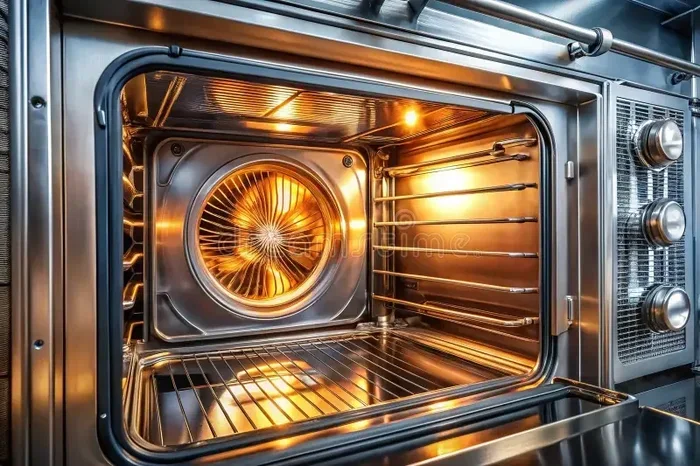
Open your oven door and look at the inside. A conventional oven has a heating element at the top and another at the bottom. These elements glow red when the oven is heating.
A convection oven has the same top and bottom elements. But it also has a third element at the back, plus a fan assembly. The fan is usually visible as a small circular opening or a hidden compartment at the back wall of the oven.
If you see a back element or a fan opening, your oven is convection. If you only see the top and bottom elements, it is conventional. Some ovens hide the fan behind a cover plate, so it may not be visible even when the oven is off.
Method 6: Check the Product Label or Sticker
Many ovens have a product label stuck to the outside. This label is usually on the side or back of the oven. It lists the model number, serial number, and key features.
Look for words like “convection,” “fan-assisted,” or “fan-forced.” These terms confirm a convection oven. If the label only mentions “thermal” or “static heat,” it is a conventional oven.
This method works especially well for freestanding ranges and wall ovens. Slide-out or built-in models might have the label on the back panel. You may need to pull the oven slightly away from the wall to see it.
Key Differences Between Conventional and Convection Ovens
Understanding the differences between these two oven types helps you cook smarter. Here is a side-by-side look at what sets them apart.
Heat Distribution
A conventional oven has uneven heat distribution. The top gets hotter, and the bottom provides steady warmth. This creates temperature zones inside the oven. Food on the top rack may cook faster than food on the bottom rack.
A convection oven distributes heat evenly throughout the cavity. The fan pushes hot air in a circular motion. This removes cold spots and hot spots. Every rack level cooks at roughly the same rate.
Cooking Time
Convection ovens cook faster. The moving hot air transfers heat to food more efficiently. You can expect a reduction in cooking time of about 20 to 25 percent.
Conventional ovens take longer because the heat moves slowly through natural convection. This is not necessarily a bad thing. Slow cooking can be better for tough cuts of meat and delicate baked goods.
Temperature Settings
When using a convection oven, you should lower the temperature by 25 degrees Fahrenheit compared to a conventional recipe. So if a recipe says 375 degrees, set your convection oven to 350 degrees.
Conventional ovens use the exact temperature stated in the recipe. There is no need to adjust because the heat is less intense and more passive.
Energy Efficiency
Convection ovens use less energy because they cook food faster. The shorter cooking time means the oven runs for fewer minutes. Over time, this can save on electricity or gas bills.
Conventional ovens use more energy for the same dish because they take longer. The oven stays on for a more extended period, which adds up over many cooking sessions.
Best Dishes for Each Type
Convection ovens excel at roasting meats, baking pastries, cooking multiple trays at once, and making crispy foods. Conventional ovens shine when baking delicate items like soufflés, custards, and cakes that need gentle, still heat.
When to Use Each Oven Mode
Knowing when to use convection or conventional mode makes a big difference in your cooking results. Let us break down the best uses for each mode.
Use Convection Mode For
- Roasting meats: Chicken, turkey, and roasts come out evenly browned and juicy.
- Baking cookies: Multiple trays cook evenly without rotating them.
- Pastries and pies: The fan creates a crispy, flaky texture.
- Reheating leftovers: Food heats faster and stays crispy.
- Drying foods: The fan removes moisture, perfect for making dried fruits or jerky.
Use Conventional Mode For
- Cakes and cupcakes: The still heat lets the batter rise properly without the fan disturbing it.
- Custards and flans: Gentle heat prevents curdling and cracking.
- Bread baking: Traditional loaves benefit from static heat for a good rise.
- Delicate sauces: Custard-based sauces and baked eggs cook gently without stirring air.
Common Mistakes People Make With Oven Types
Even experienced cooks sometimes make mistakes when using different oven types. Here are the most common errors and how to avoid them.
Not Adjusting the Temperature
The biggest mistake is using the same temperature for both oven types. If you bake a cake in a convection oven at the recipe temperature, it will overbake or burn. Always reduce the temperature by 25 degrees when using convection mode.
Opening the Door Too Often
Every time you open the oven door, you lose heat. In a convection oven, you also disrupt the airflow. This slows down cooking and creates uneven results. Try to check your food only when necessary.
Overcrowding the Oven
While convection ovens handle multiple trays better, you still should not overcrowd them. Blocking the airflow with too many pans reduces the benefits of the fan. Leave space between trays for the hot air to circulate.
Ignoring the Fan Setting
Many ovens have a convection toggle but people forget to turn it on or off. If you are following a recipe written for a conventional oven, make sure the convection mode is off. Otherwise, your cooking times and temperatures will be off.
Not Knowing Your Oven Runs Hot
Some ovens, whether conventional or convection, run hotter than the display shows. This is a common issue. Invest in an oven thermometer. Place it inside and compare the reading to the set temperature. This simple tool takes the guesswork out of baking.
Expert Tips for Getting the Most From Your Oven
Whether you have a conventional or convection oven, these expert tips will improve your cooking results immediately.
First, always preheat your oven. Both oven types work best when they reach the target temperature before food goes in. Preheating ensures even cooking from the very first minute.
Second, rotate your pans halfway through cooking. Even convection ovens can have slight variations. Rotating your trays ensures everything browns evenly. This is especially important when baking multiple trays of cookies or muffins.
Third, use light-colored baking pans. Dark pans absorb more heat and can cause over-browning, especially in convection ovens. Light pans reflect heat and give you more control over browning.
Fourth, keep your oven clean. Grease and food residue on the walls can smoke and affect food flavor. A clean oven also heats more evenly because there is no buildup blocking the heat elements.
Fifth, learn your specific oven. Every oven is slightly different. Spend time experimenting with your oven’s hot spots, fan strength, and temperature accuracy. Once you know your oven, you will always get great results.
Frequently Asked Questions
Can a conventional oven be converted to a convection oven?
No, you cannot convert a conventional oven to a convection oven. A convection oven has a fan and a back heating element built into its design. These components cannot be added to a conventional oven without major modifications. If you want the benefits of convection, you would need to replace your oven with a convection model.
Is a convection oven better than a conventional oven for baking?
It depends on what you are baking. Convection ovens are excellent for pastries, cookies, and roasted dishes because they cook faster and more evenly. However, conventional ovens are better for delicate baked goods like cakes and soufflés that need gentle, still heat. Many bakers use both modes depending on the recipe.
How do I know if my oven has a convection feature if it was built in?
Built-in ovens often have a convection feature even if it is not obvious. Check the control panel for a fan icon or a convection setting. You can also look up the model number online or check the product specifications in the manual. Most modern built-in ovens include a convection fan as a standard feature.
Do I need to adjust cooking times for a convection oven?
Yes, you should adjust both the temperature and the cooking time. Lower the temperature by 25 degrees Fahrenheit and reduce the cooking time by about 25 percent. However, the exact adjustment depends on what you are cooking. Start checking your food a few minutes earlier than the recipe suggests.
Are all wall ovens convection ovens?
No, not all wall ovens are convection ovens. Some wall ovens are conventional only. Others are combination ovens that offer both modes. You need to check the specifications of your specific wall oven model to know for sure.
Can you use aluminum foil in a convection oven?
Yes, you can use aluminum foil in a convection oven, but with caution. Avoid covering the fan or blocking airflow with foil. Foil can reflect heat and help with browning, but it should never touch the heating elements or obstruct the fan’s movement.
Conclusion
Now you know exactly how to tell if oven is conventional or convection. You have several reliable methods to check, from examining the control panel to listening for the fan during cooking. Each method is simple and takes only a few minutes.
Understanding your oven type is one of the most valuable skills in the kitchen. It helps you cook with better results, save energy, and follow recipes with confidence. Whether your oven is a conventional model or a convection model, knowing how it works puts you in control of every meal you prepare.
Take a moment right now to check your oven. Use one of the methods from this guide. You might be surprised by what you find. Once you know your oven type, you will never look at a recipe the same way again. Cook with confidence, adjust your settings wisely, and enjoy every meal you make.